

Description
Product details
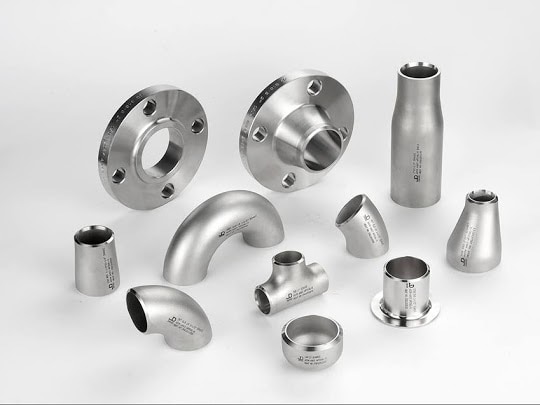
Stainless Steel Buttweld Pipe Fittings and Flanges, commonly used to create permanently welded, leak-proof industrial piping systems.⚙️ Main Components IdentificationTop Row (Flanges & Reducers):Slip-On Flange (Top Left): A flat ring flange that slides over the end of a pipe before being welded in place.Weld Neck Flange (Top Middle): Features a tapered hub that is directly butt-welded to a pipe, designed for severe high-pressure or extreme temperature systems.Concentric Reducer (Top Right): A cone-shaped fitting used to join two inline pipes of different diameters while maintaining a shared centerline.Middle Row (Elbows & Tees):180° Return Bend (Center): A U-shaped fitting used to reverse the direction of fluid flow completely.45° Elbow (Middle Right): Changes pipeline direction by 45 degrees to navigate tight spaces gently.Equal Tee (Bottom Center): A T-shaped branch fitting used to combine or split fluid flow into a 90-degree line.Bottom Row (Elbows, Caps & Stub Ends):90° Long Radius Elbow (Bottom Left): Standard fitting used to change fluid flow direction by 90 degrees with minimal friction loss.Pipe Cap (Bottom Middle): A dome-shaped fitting used to seal off or terminate the dead end of a pipeline.Lap Joint Stub End (Bottom Right): Paired with a loose backing flange to allow easy line alignment and rapid disassembly during maintenance.💡 Material & Installation AdvantagesSeamless Strength: Because these fittings are butt-welded directly to the pipes, they create a continuous metal structure that offers maximum resistance to high pressures, leaks, and structural stress.Smooth Flow Profile: The internal surface matches the pipe's internal diameter perfectly, reducing turbulence, pressure drops, and fluid erosion inside the line.Would you like to know how to match these fittings to a specific pipe schedule (like Schedule 10 vs. Schedule 40), or do you need help identifying material grades (such as 304L vs. 316L) for corrosive environments