

Description
Product details
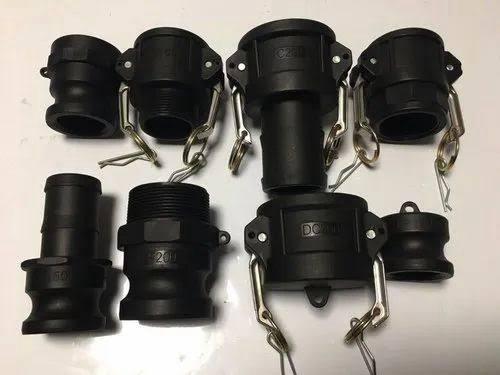
Polypropylene (Plastic) Camlock Couplings (also known as cam and groove couplings or quick-disconnect fittings).Unlike the heavy-duty stainless steel components we discussed earlier, these are lightweight, rust-proof, and budget-friendly alternatives designed for fast, tool-free hose connections.⚙️ How the System WorksThe camlock system relies on a simple male-and-female interlocking mechanism:A Male Adapter (plug) slides smoothly inside a matching Female Coupler (socket).The operator presses the silver side cam arms downward.The arms lock into a deep groove on the male plug, pulling it tight against an internal rubber gasket to establish an instant, leak-proof seal.🧱 Component Identification GuideCamlock fittings are globally standardized by “Type” letters based on their end connections. The layout shows:Type C Coupler (Top Row, 3rd from left): A female coupler on one end with a ridged hose shank (barb) on the other, designed to push directly inside a flexible hose line.Type B or D Coupler (Top Row, 2nd and 4th from left): Female couplers equipped with either internal female threads or external male threads to screw directly onto rigid pipe networks or pump manifolds.Type E Adapter (Bottom Row, far left): A male plug with a hose shank barb for flexible tubing connections.Type F Adapter (Bottom Row, 2nd from left): A male plug featuring external male pipe threads (marked 200, indicating a standard 2-inch nominal size).Dust Cap & Plug (Bottom Row, right side): Used to seal off open pipe ends when the primary hose lines are disconnected, protecting the fluid system from dirt, insects, and debris.🔧 Primary Applications & Material BenefitsBecause they are molded from high-density polypropylene, they offer unique advantages:Chemical & Acid Resistance: Highly resistant to aggressive liquid fertilizers, agricultural pesticides, and mild industrial acids that would corrode brass or steel.Agriculture & Irrigation: Widely used on mobile water tankers, crop sprayers, and farm irrigation pumps for quick field breakdown.Pumping & Dewatering: Connecting suction and discharge hoses on portable construction or municipal water bypass pumps.Pressure Constraint Note: Polypropylene fittings are designed for low-pressure utility service (typically under 100–125 PSI depending on size) and should never be used for compressed air or gas lines.If you are setting up a chemical transfer system or water bypass loop, let me know:What nominal size (such as 1-1/2“ or 2”) are you trying to adapt?What fluid or chemical will be moving through these lines?Do you need help choosing between standard NBR/Buna-N gaskets or chemically inert Viton/PTFE gaskets for your fluid?I can help ensure you select the correct thread style and gasket compound for a safe setup!