
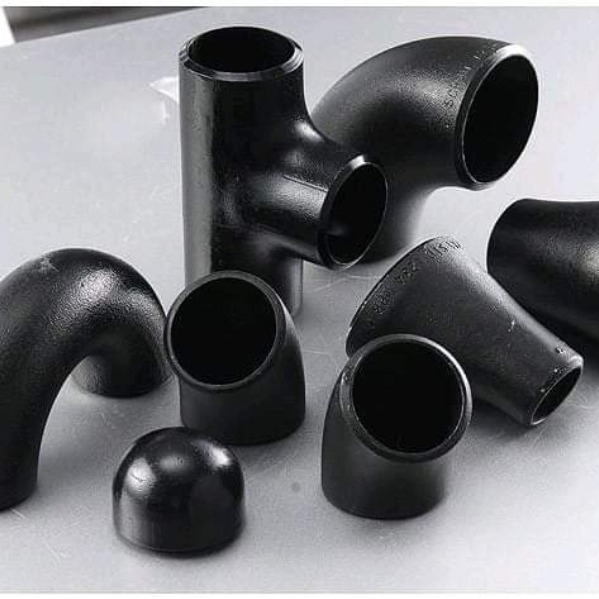
Stainless Steel (SS) and Carbon Steel (CS) pipe fittings are essential components used to connect, redirect, or terminate piping systems in industrial, commercial, and residential applications. SS fittings (e.g., 304, 316) offer high corrosion resistance, while CS fittings provide high strength, with both featuring butt-weld, threaded, or socket-weld ends to handle varied pressure and temperature needs. Key Aspects of SS and CS Pipe Fittings Common Materials & Grades: Stainless Steel (SS): Commonly grades 304/304L (versatile) and 316/316L (high corrosion resistance). Carbon Steel (CS): Provides high strength and durability, often used in structural or high-pressure applications where corrosion is not the primary concern. Types of Fittings: Elbows: 45°, 90°, and 180° for changing direction. Tees & Crosses: For branching or combining fluid flow. Reducers: Concentric or eccentric to connect different diameters. Couplings & Unions: For joining pipes, including threaded options. Caps & Plugs: To seal the end of a pipe. Flanges: For connecting valves or equipment. Joining Methods: Butt-weld: Permanent, leak-proof, high-strength connections (ASTM A403 for SS). Socket-weld: High-pressure applications, fitting with a socket. Threaded: Often used for low-pressure, smaller diameter pipes. Key Characteristics: SS: Corrosion resistance, low maintenance, hygiene-friendly. CS: High tensile strength, durable, generally more cost-effective. Common Applications: SS: Chemical processing, food/beverage, marine, pharmaceutical, plumbing. CS: Oil and gas pipelines, structural, water lines, HVAC.


This is your website preview.
Currently it only shows your basic business info. Start adding relevant business details such as description, images and products or services to gain your customers attention by using Boost 360 android app / iOS App / web portal.
Stainless Steel (SS) and Carbon Steel (CS) pipe fittings
2026-04-07T13:30:08
Stainless Steel (SS) and Carbon Steel (CS) pipe fittings are essential components used to connect, redirect, or terminate piping systems in industrial, commercial, and residential applications. SS fittings (e.g., 304, 316) offer high corrosion resistance, while CS fittings provide high strength, with both featuring butt-weld, threaded, or socket-weld ends to handle varied pressure and temperature needs. Key Aspects of SS and CS Pipe Fittings Common Materials & Grades: Stainless Steel (SS): Commonly grades 304/304L (versatile) and 316/316L (high corrosion resistance). Carbon Steel (CS): Provides high strength and durability, often used in structural or high-pressure applications where corrosion is not the primary concern. Types of Fittings: Elbows: 45°, 90°, and 180° for changing direction. Tees & Crosses: For branching or combining fluid flow. Reducers: Concentric or eccentric to connect different diameters. Couplings & Unions: For joining pipes, including threaded options. Caps & Plugs: To seal the end of a pipe. Flanges: For connecting valves or equipment. Joining Methods: Butt-weld: Permanent, leak-proof, high-strength connections (ASTM A403 for SS). Socket-weld: High-pressure applications, fitting with a socket. Threaded: Often used for low-pressure, smaller diameter pipes. Key Characteristics: SS: Corrosion resistance, low maintenance, hygiene-friendly. CS: High tensile strength, durable, generally more cost-effective. Common Applications: SS: Chemical processing, food/beverage, marine, pharmaceutical, plumbing. CS: Oil and gas pipelines, structural, water lines, HVAC.
2026-04-07T13:30:08


 and Carbon Steel (C)

Submit Your Enquiry